For over a century, the automotive industry judged a vehicle’s prestige by what sat under the hood: cylinder counts, torque curves, and raw mechanical horsepower. But step inside a modern vehicle today, and it becomes immediately clear that the engine is no longer the sole star of the show.
We are living through the transition from hardware-driven machines to Software-Defined Vehicles (SDVs). Powered by artificial intelligence, today’s cars don’t just carry us from point A to point B—they perceive their surroundings, learn our daily habits, and continuously update their own behavior.
Whether you’re a tech enthusiast eager for full autonomy or a casual driver curious about why your car suddenly talks back to you, here is what AI in cars looks like today, what is already locked in for tomorrow, and where the road leads in the distant future.
1. Present Day: The AI Already Riding Shotgun
You don’t need to ride in a experimental prototype to experience automotive AI. Today’s consumer vehicles are already packed with machine learning algorithms designed around three core areas: safety, interaction, and vehicle health.
Chevy
- Native Telemetry AI: GM is deploying a next-generation conversational assistant powered by Google Gemini across OnStar-equipped vehicles. Unlike basic voice commands, this AI taps directly into live vehicle telemetry to answer complex diagnostic questions, manage battery thermal pre-conditioning, and adjust cabin controls via natural speech.
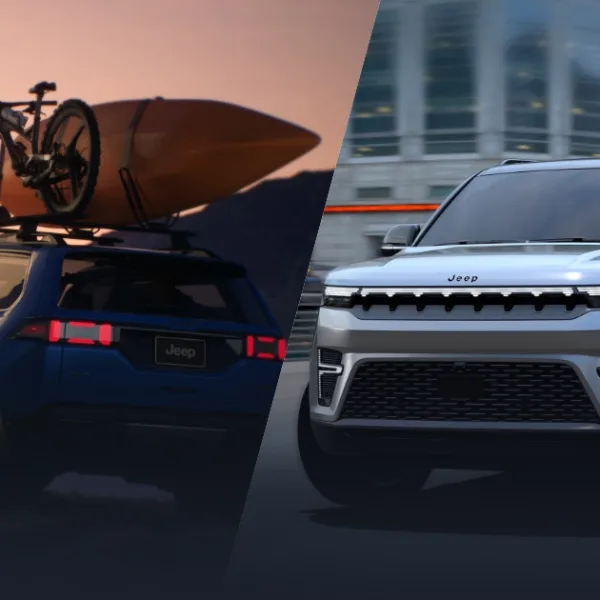
Jeep, Dodge, Ram, & Chrysler
- STLA Brain & SmartCockpit: Stellantis is deploying AI across all four North American brands through its STLA software platforms.
- Generative Assistants: Through a partnership with Mistral AI, vehicles across the Jeep, Dodge, Ram, and Chrysler lineups are gaining generative AI co-pilots. These act as interactive, conversational owner’s manuals and natural voice navigators.
BMW & Mini
- LLM Intelligent Assistant: BMW is integrating Large Language Models (developed in partnership with Amazon) into its BMW Intelligent Personal Assistant for fluid, multi-step voice controls and proactive route recommendations.
- Mini Intelligent Avatar: Mini inherits BMW’s AI software stack, introducing generative voice assistants (featuring digital avatar companions like Spike) that learn individual driver preferences, seating setups, and commuting habits over time.
Kia
- Kia AI Assistant: Kia officially debuted its generative AI voice system on models like the EV3, expanding across its connected car Navigation Cockpit (ccNC) architecture. Drivers can engage in natural, open-ended conversations to manage charging stops, adjust vehicle settings, and query owner manual details on the fly.
Jaguar & Land Rover
NVIDIA DRIVE Platform: JLR has partnered with NVIDIA to build all upcoming vehicles on centralized AI computing architectures. This powers real-time interior occupant monitoring, surround-vision sensor fusion, predictive safety alerts, and Level 2+/3 automated driving capabilities updated over-the-air.
2. Confirmed Future Plans: The Next 2 to 5 Years
The near-future roadmap for automotive AI is already well underway in engineering labs and manufacturing plants. Over the next few years, drivers will experience a structural shift in how vehicles operate and upgrade.
Centralized Edge Computing & OTA Evolution
Historically, a car relied on dozens of separate electronic control units (ECUs)—tiny computers dedicated to isolated tasks like controlling windows or power steering. The next generation of vehicles is shifting to centralized compute architectures. Powerful automotive System-on-Chips (SoCs), like NVIDIA’s DRIVE Thor platform, serve as a single “brain” running cabin intelligence, automated driving, and digital instrument clusters simultaneously. This centralized design makes over-the-air (OTA) updates far more capable, allowing automakers to deploy improved driving algorithms or new features long after the car leaves the dealership lot.
Expanding Conditional Autonomy (Level 3 & Level 4)
While full Level 5 “drive anywhere” autonomy is still undergoing testing, confirmed rollouts of Level 3 conditional autonomy are accelerating. Level 3 systems allow drivers to legally take their eyes off the road and hands off the wheel under specific conditions (such as traffic jams on designated highways), with the vehicle assuming legal liability while active. Meanwhile, commercial Level 4 robotaxi platforms (like Waymo and Zoox) continue expanding their driverless coverage zones across major metropolitan areas, proving out multi-sensor fusion at scale.
Augmented Reality Windshields
Traditional Head-Up Displays (HUDs) project simple speedometers onto the glass. The next generation utilizes AI-driven vision models paired with spatial projection to create true Augmented Reality HUDs. Navigation directions will appear as virtual arrows painted directly onto the asphalt ahead, while potential hazards—like a pedestrian stepping out behind a parked truck—will be highlighted on the glass before your eyes catch them naturally.
3. The Distant Horizon: What Transportation Could Become
Looking beyond the next decade, AI has the potential to fundamentally transform the car from a personal tool into an interconnected node within a larger mobility ecosystem.
- V2X Swarm Intelligence: Vehicle-to-Everything (V2X) communication will allow cars to exchange real-time sensor streams with each other and smart infrastructure. An AI in your car will “see” around blind corners through the cameras of an oncoming vehicle, eliminating accidents caused by obstructed sightlines and synchronizing traffic flow to eliminate gridlock.
- Biometric & Health Copilots: Cabin interiors will monitor driver vitals, pupil movement, and stress levels through non-invasive sensors. If the system detects a severe medical emergency (like a heart attack or stroke), the vehicle can automatically take control, alert emergency services, and navigate safely to the nearest hospital.
- Reconfigurable Mobile Spaces: Once Level 5 autonomy achieves full capability, driving controls—steering wheels, pedals, dashboards—can disappear entirely. Cabin interiors will reconfigure into mobile lounges, working conference pods, or sleeping quarters, converting commuting time into productive or restful personal space.
The Takeaway
The automobile is no longer defined strictly by mechanical engineering. We are moving rapidly toward an era where a car’s intelligence, adaptability, and software depth define its value just as much as its build quality. As AI continues to evolve from basic driver support into autonomous co-piloting and smart city integration, the act of driving is changing forever—and the journey is just getting started.